.jpg)
Industry's demand for a reduction in the repo rate, currently 8 per cent, has gained momentum after wholesale and retail inflation eased in February.

After unseasonal rains, supply disruptions and pandemic-induced woes pushed retail inflation well over the Reserve Bank's comfort zone in 2020, the scenario is likely to stay that way at least in the short term as economic recovery slowly gains foothold. For most part of this year, pricier food items pushed the retail inflation, based on Consumer Price Index (CPI), higher in the range of 6.58-7.61 per cent, except for March when the reading was 5.91 per cent. Experts believe retail inflation is likely to average around 6.3 per cent this fiscal and mostly will remain sticky going forward owing to pick-up in demand across sectors.

Weakness in the rupee against the US dollar also weighed on domestic stocks. The local unit fell 11 paise to 70.60 against the US dollar intra-day.

Inflation target remains 5% for January 2017.

Follow these tips to get ready to celebrate with sweets and kites with your friends and family in your new house next Pongal.
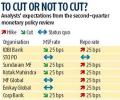
Analysts expect RBI to restore 100-bp corridor in Tuesday's policy review.

Das said banks have passed only 0.29 per cent in rate cuts to their borrowers as against 0.75 per cent cuts in interest rates by the Reserve Bank till June.
At least a 25 basis points hike can be expected on the October 5 policy

Rediff.com interviewed people from several walks of life to know their opinions on the rise in rates by RBI.

The Reserve Bank's growth projection for next financial year is lower than 8-8.5 per cent projected by the finance ministry in the recent Economic Survey which was tabled in Parliament on January 31. Unveiling the bi-monthly policy, RBI governor Shaktikanta Das said, "Recovery in domestic economic activity is yet to be broad-based, as private consumption and contact-intensive services remain below pre-pandemic levels."

The central bank had nudged banks to cut lending rates.

The central bank might raise repo and reverse repo rates by 25 basis points each, they said. Still, RBI action would be conditional on its ensuring sufficient liquidity in the banking system.

Spiralling prices pinched the pocket of consumer as edible oil, fuel and many other commodities turned dearer this year amid pandemic-induced disruptions but the inflationary pressure is anticipated to ease, though marginally, in the coming months. As consumers, at retail as well as wholesale levels, are willy-nilly learning to live with the new normal of curbs to contain the spread of coronavirus infections, experts are of the view that elevated inflation is likely to stay longer. After dealing with the devastating blows from the second COVID wave, especially during the April-June period, the economy is well on the revival path but the emergence of Omicron might unsettle the recovery trajectory in the short term.

'Any normalisation exercise will bring its share of volatility.'

What is killing the risk appetite of the bond buyers is the inconsistency in the central bank's approach. It needs to allow the yield to find its own level, gradually. To ensure that, the RBI may adopt a similar approach with which it handles a slipping rupee, asserts Tamal Bandyopadhyay.

The S&P BSE Midcap and the S&P BSE Smallcap indices added 0.5% and 0.7%, respectively

Rajan said the central bank has used up all its "space available" to cut interest rates
The RBI wants CPI inflation to ease further to 6 per cent by January 2016.

All-out efforts are needed to mitigate the adverse impact of the Covid-19 pandemic, and the RBI will use any instrument necessary to revive growth and preserve financial stability, according to the minutes of the central bank's policy meeting.

Banks led the decline with Nifty Bank and BSE Bank index dropping over 3% each.

Bankers have been criticised for not passing the benefits of rate cuts

If banks have a surplus, they have the option of parking the money with the RBI.

As per the data released by the NSO, the overall food inflation rose to 14.12 per cent in December as against (-) 2.65 per cent in the same month of 2018.

Investors should look at short term or floating rate schemes for market based returns.

RBI said at the current juncture, the all-out effort is to maintain and sustain, with the hope that when life is secure, resources, energy and time can be marshalled to rebuild and revive.

RBI, in its first bi-monthly monetary policy statement, left the short-term lending rate, or repo rate, unchanged at 8 per cent and the cash reserve ratio static at 4 per cent.

None of the four benchmarks suggested by the RBI is ideal as banks in India create loan assets from their deposits and not borrowing from the regulator or market, says Tamal Bandyopadhyay.
Central bank may raise the limit on repo borrowings or purchase more of govt bonds.

The fifth meeting of Monetary Policy Committee maintained the repo rate, at which it lends to the banks, at 6.25 per cent and the reverse repo, at which it borrows, will be 6 per cent.
The CPI and WPI data for December 2013 holds the key for the third-quarter monetary policy review to be announced later this month.

RBI Governor has been under pressure from Finance Ministry.

The central bank tweaked the retail inflation range to 4.8-4.9 per cent in the first half of 2018-19, and 4.7 per cent in the second half.

The final guidelines to link the interest rate to external benchmarks will be issued by the end of this month

Finance Minister Pranab Mukherjee on Tuesday said the Reserve Bank's decision to hike short-term borrowing and lending rates will help contain inflation and was in line with the government's policy.

The RBI has this year cut interest rates by 110 basis points in four instalments but banks have passed only a part of it to borrowers. Before the last reduction earlier this month of 35 basis points, the bank on an average had passed only 29 basis points out of 75 basis points cut affected during 2019.
In his first monetary policy review since taking office on September 4, RBI Governor Raghuram Rajan increased the repo rate by 25 basis points to 7.50 per cent.

He did not believe in any fiscal puritanism. In 2012, when it was almost certain that the government will breach the 2012-13 fiscal deficit target, he wrote that in abnormal times, abnormal measures are required to get back to normalcy.

The Reserve Bank remains laser-focused to bring back retail inflation to 4 per cent over a period of time in a non-disruptive manner, Governor Shaktikanta Das stressed while voting for status quo in interest rates, as per minutes of the October policy meeting released on Friday. The central bank has been mandated by the government to ensure the Consumer Price Index (CPI) based inflation is at 4 per cent, with a band of 2 per cent on either side. The retail inflation, which was above 6 per cent during May and June, has started moving down and stood at 4.35 per cent in September.
The most recent RBI effort could be the final push that would allow enough and more room for banks, builders and buyers to start moving towards change.

The career bureaucrat-turned-central banker walked into the 19th floor corner room of the Reserve Bank on December 12, 2018. Since February 2019, the Das-led RBI has cut the repo rate by a whopping 135 basis points to support the sagging growth, including an unprecedented 35 bps reduction in August. As he completes one year at the helm, woes in the NBFC sector, overall health of the banking sector and steeply falling economic growth are among the major challenges that needs to be tackled sooner than later.
